
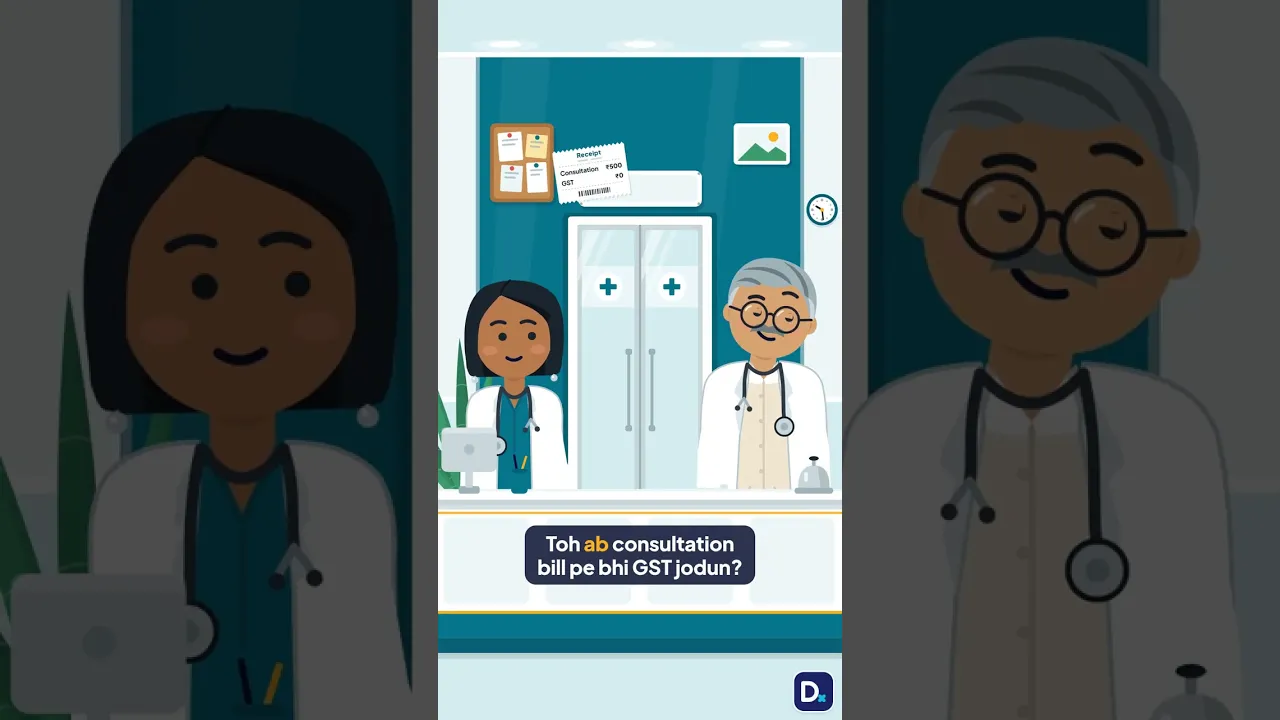
You do not charge GST on a consultation, a treatment or a test at your clinic. The law exempts health care given by a registered doctor or a clinic. GST applies only to your other income: cosmetic work, medicines sold over the counter, and rent you earn.
What you need
- A list of every way your practice earns money. Use the table below to sort each one.
- Your council registration. It shows you are an authorised doctor.
- Last year's total receipts, from all sources. You need this number for the registration test.
- Time: about 15 minutes to sort, if your accounts are tidy.
- Cost: nothing, unless you choose to register for GST. The GST portal does not charge a fee to apply.
Your medical work
If you are a registered doctor, your medical work carries no GST. The rate is zero. This holds for a clinic and for a hospital. An ambulance that carries a patient is exempt too.
Three words matter here.
Health care means any service to find or treat an illness, an injury, a deformity, an abnormality or a pregnancy. It also covers taking the patient to and from a clinic. It is not limited to modern medicine. AYUSH counts if the system is recognised in India.
Authorised doctor means a doctor registered with a council of a recognised system of medicine. Your state or national council registration is your proof.
Clinic means a hospital, nursing home, clinic, sanatorium or any other institution. A place set up for tests or scans counts too. So a lab or an X-ray room inside your clinic fits.
The rule does not make a state licence a condition. Check with your CA. If a tax officer asks, show your council certificate.
Cosmetic work
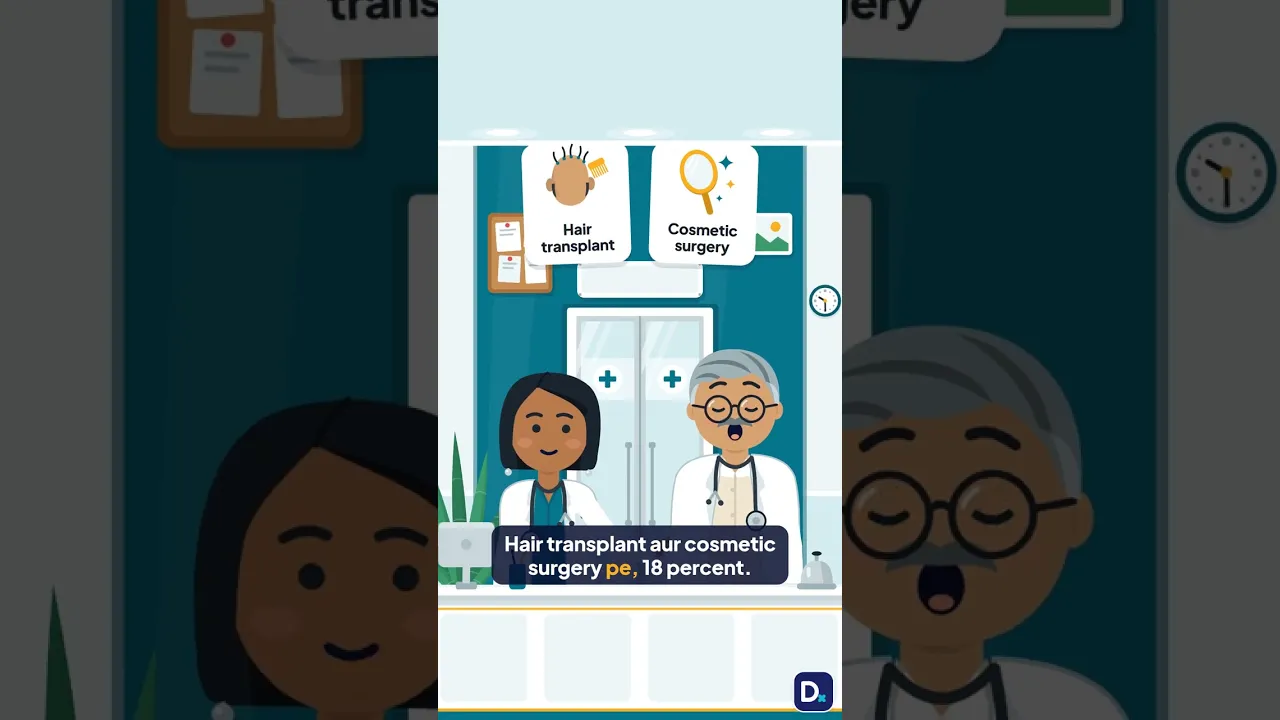
Hair transplant, cosmetic surgery and plastic surgery are not health care for GST. They carry 18% GST. That is 9% central tax plus 9% state tax.
One part stays exempt. Surgery that restores or rebuilds the body is still exempt. This covers birth defects, growth problems, injury and trauma.
The rule does not list procedures. A simple test helps. Treating an illness or repairing damage is exempt. Changing how someone looks, on request, is cosmetic. For borderline cases, ask your CA.
GST on each kind of income
| Income type | GST position |
|---|---|
| Consultation, OPD visit, follow-up (in clinic) | Exempt |
| Online consultation | Exempt. The rule covers any service to find or treat an illness. The patient need not be in the room. |
| Treatment, minor procedures, surgery to treat illness or injury | Exempt |
| Lab tests, X-ray, scans done at your clinic | Exempt |
| Ambulance carrying a patient | Exempt |
| Surgery after injury, trauma or a birth defect | Exempt |
| Hair transplant, cosmetic or plastic surgery done for looks | Taxable at 18% |
| Room for an admitted patient, up to ₹5,000 a day | Exempt |
| ICU, CCU, ICCU or NICU bed, at any price | Exempt |
| Room for an admitted patient, over ₹5,000 a day (not ICU) | Taxable at 5%, with no input credit |
| Medicines or products sold over the counter or at a pharmacy | Taxable. It is a sale of goods, at the rate for that item. Look it up on the CBIC rate finder. |
| Medicines given to an admitted patient as part of treatment | Check with your CA |
| Rent you earn from letting a clinic room or shop | Taxable at 18% |
| Speaker fees, advisory fees, clinical trial fees, expert opinion for a company | Usually taxable at 18%. It is not diagnosis, treatment or care. Check with your CA for your case. |
Every 18% figure is 9% central tax plus 9% state tax.
The daily rent limit
If you run beds, this rule matters. It has applied since 18 July 2022.
Hospital rooms over ₹5,000 a day (not ICU) carry 5% GST. Rooms at or below ₹5,000 a day stay exempt. ICU, CCU, ICCU and NICU beds stay exempt at any price.
The 5% is 2.5% central tax plus 2.5% state tax. It applies on one condition: you have not claimed input tax credit on the room.
Two points to note:
- The tax is on the room charge only. Your treatment, procedures and doctor fees stay exempt.
- The test is the charge to each patient. Check the daily room charge for every person.
Do you need a GST number?
Three tests decide this. Work through them in order.
1. Is all your income exempt? Then you do not need to register. The law says a person who supplies only exempt goods or services is not liable to register. A doctor who only consults and treats is in this group.
2. Do you also have taxable income? Then count your total. Once your total for a year goes over ₹20 lakh, you must register. In special category states the limit is ₹10 lakh. The Centre can raise it up to ₹20 lakh if a state asks. Check your state.
Here is the key point. Your total adds up everything: taxable sales, exempt fees, exports and sales to other states. It is counted across India for one PAN. So your consultation fees count towards the limit, even though they carry no GST.
An example. A doctor earns ₹30 lakh from consultations and ₹1 lakh from selling medicines. The total is ₹31 lakh. The medicine sales are taxable. That doctor must register.
3. Do you sell goods to another state? Then you must register, whatever your total. This holds for any taxable sale of goods to another state.
A higher ₹40 lakh limit exists for goods. It does not help you. It is only for people who supply goods and nothing else. A doctor with consultation income is not in that group.
How to register
- Open the new registration page on the GST portal.
- Fill Part A with your PAN, mobile number and email. Verify them with the codes sent.
- Fill Part B with your clinic address, bank details and documents.
- Submit, and keep the application number.
If your income is exempt
Input tax credit (ITC) lets a registered seller subtract the GST paid on purchases. Exempt income changes this.
You can claim credit only on purchases used for taxable sales. If every rupee you earn is exempt, you get no credit. Any GST on your equipment, furniture, AC or rent is part of your cost.
If you have both kinds of income, you claim credit only for the taxable part. The GST rules fix how to split it. Ask your CA to set the method once, at the start of the year.
A pharmacy counter is the common case. GST on medicines you buy to resell is creditable against GST on your sales. GST on the clinic's consulting-room chair is not.
Invoices and receipts
- If you are not registered, GST does not appear on your receipt. Give a plain receipt with your name, registration number, date and amount.
- If you are registered and your service is exempt, issue a "bill of supply". It replaces the tax invoice.
- If you sell a taxable item, issue a tax invoice with your GST number and the tax shown.
- Never add GST to an exempt fee. It is not owed. If it happened, ask your CA how to fix it.
Common mistakes
- Treating all clinic income as exempt. Cosmetic work, pharmacy sales and rent you earn are not.
- Leaving exempt fees out of your total. They count towards the registration limit.
- Charging GST on a consultation. There is no GST on it.
- Missing the room rent rule. If you run beds, check each room charge against ₹5,000 a day.
- Claiming credit on GST paid for an exempt service. The law blocks it.
- Forgetting the GST on rent you pay. A registered landlord charges 18%. You cannot claim it back if your work is exempt.
If it goes wrong
- You crossed the limit and did not register. Apply on the portal now. Tell your CA the date you crossed. Do not wait for a notice.
- A tax notice arrives. Reply on the GST portal before the date on it. Attach your council certificate, your clinic proof and a note on each income stream.
- You charged GST on an exempt fee. Tell your CA. Patients should not pay tax that is not owed.
Related guides
- Open a clinic in India: every licence you need
- Professional tax for doctors, state by state
- Clinical Establishments Act registration
Sources
All checked on 30 Oct 2026. Notification and section numbers are listed here.
- CBIC, Notification 12/2017-Central Tax (Rate): 28 Jun 2017. Entry 74 (nil rate for health care services, and for an ambulance carrying a patient) and clauses 2(k), 2(s) and 2(zg) (the three definitions, and the cosmetic exception).
- CBIC, Notification 04/2022-Central Tax (Rate): 13 Jul 2022, in force 18 Jul 2022. The room charges proviso to entry 74 (over ₹5,000 a day, ICU, CCU, ICCU and NICU left out).
- CBIC, Notification 03/2022-Central Tax (Rate): 13 Jul 2022. Entry 31A (the 5% rate on room charges over ₹5,000, with no input credit taken).
- CBIC, Notification 11/2017-Central Tax (Rate): 28 Jun 2017. Sl. 16 (rent, 18%), Sl. 21(ii) (speaker, advisory and expert fees) and Sl. 31 (taxable health services, 18%).
- CBIC, CGST Act, 2017: updated to 31 Aug 2021. Section 2(6) (what counts in your total), section 9 (tax on sale of goods), section 17(2) (credit only for taxable sales), section 22 (₹20 lakh and ₹10 lakh limits), section 23(1)(a) (exempt-only suppliers need not register), section 24(i) (sales of goods to another state) and section 31(3)(c) (bill of supply).
- GST Council, Notification 10/2019-Central Tax: 7 Mar 2019, in force 1 Apr 2019. The ₹40 lakh limit for people who supply only goods.
- GST Council, CGST rate notifications: we read the amendments to 12/2017 from 2023 to Notification 16/2025 (17 Sep 2025). None changed entry 74 or the room rule.
- GST portal, new registration and CBIC rate finder.
Last checked 30 Oct 2026.
General information. Your CA can confirm what applies to you.